Representational Control over Self-Report & Behavior
Coherence in LLM Risk-Taking

1California Institute of Technology; 2Carnegie Mellon University; 3University of Illinois Urbana-Champaign; 4University of Cambridge
Status: Preprint, 2026
Framework overview: diagnosing and controlling self-report--behavior dissociation

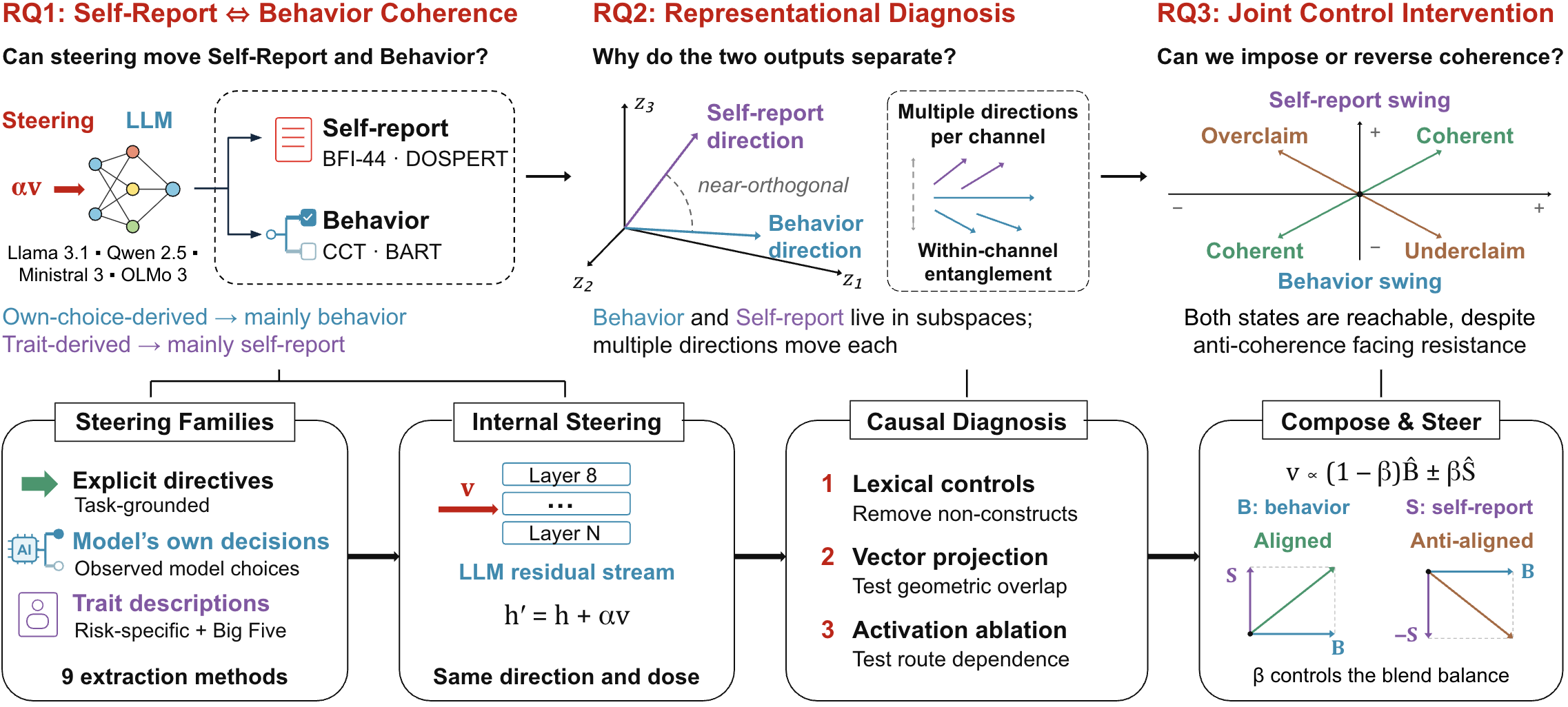
We study the self-report–behavior gap from inside the model. Using activation steering, the same internal intervention is applied at the same dose whether the model is answering a questionnaire or performing a risk-taking task. We compare nine steering-vector extraction methods across four supervision families — task directives, the model's own task decisions, risk-specific dispositions, and Big Five profiles — over four open-weight LLMs, two behavioral tasks, and two self-report instruments, asking (RQ1) whether steering moves both channels together, (RQ2) whether dissociation reflects lexical shortcuts, geometric separation, or downstream dependence, and (RQ3) whether composing directions can restore coherence or induce anti-coherence.

Abstract

Self-report is an appealing low-cost probe of an LLM's dispositions, but recent work finds only selective agreement between what models report and how they behave. Prior accounts establish these patterns by prompting black-box LLMs, leaving open whether the gap is a prompting artefact or a fact about how the underlying constructs are represented internally. We investigate risk-taking, a consequential dimension of agentic decision-making, using activation steering to measure self-report and behavior under the same internal intervention. We survey nine steering-vector extraction methods spanning task-specific directives, the model's own task behavior, and dispositional descriptions at two granularities, evaluated on two behavioral tasks and two psychometric instruments across four open-weight LLMs. We find that (1) a shared internal intervention does not ensure shared responsiveness: directions built from trait descriptions move self-report but leave behavior at chance, directions built from the model's own task choices do the reverse, and only task-specific directives reach both, weakly. (2) Diagnosis dissolves that exception: removing surface confounders leaves the directives only 32% of their behavioral effect. The two channels are otherwise steered by near-orthogonal directions, each channel reachable by several independent constructions. (3) An intervention composing one behavior-moving and one self-report-moving direction moves both together; flipping one sign sets them in opposition, with reported and enacted risk pointing in opposite directions on 69–89% of flipped compositions in all models. These findings move the self-report↔behavior relationship from a black-box observation to a representational one that can be inspected and controlled, motivating representational checks alongside behavioral evaluation.
RQ1 (Representational Coherence): Does representational steering replicate dissociation patterns?

RQ1 results: which channel each supervision family moves

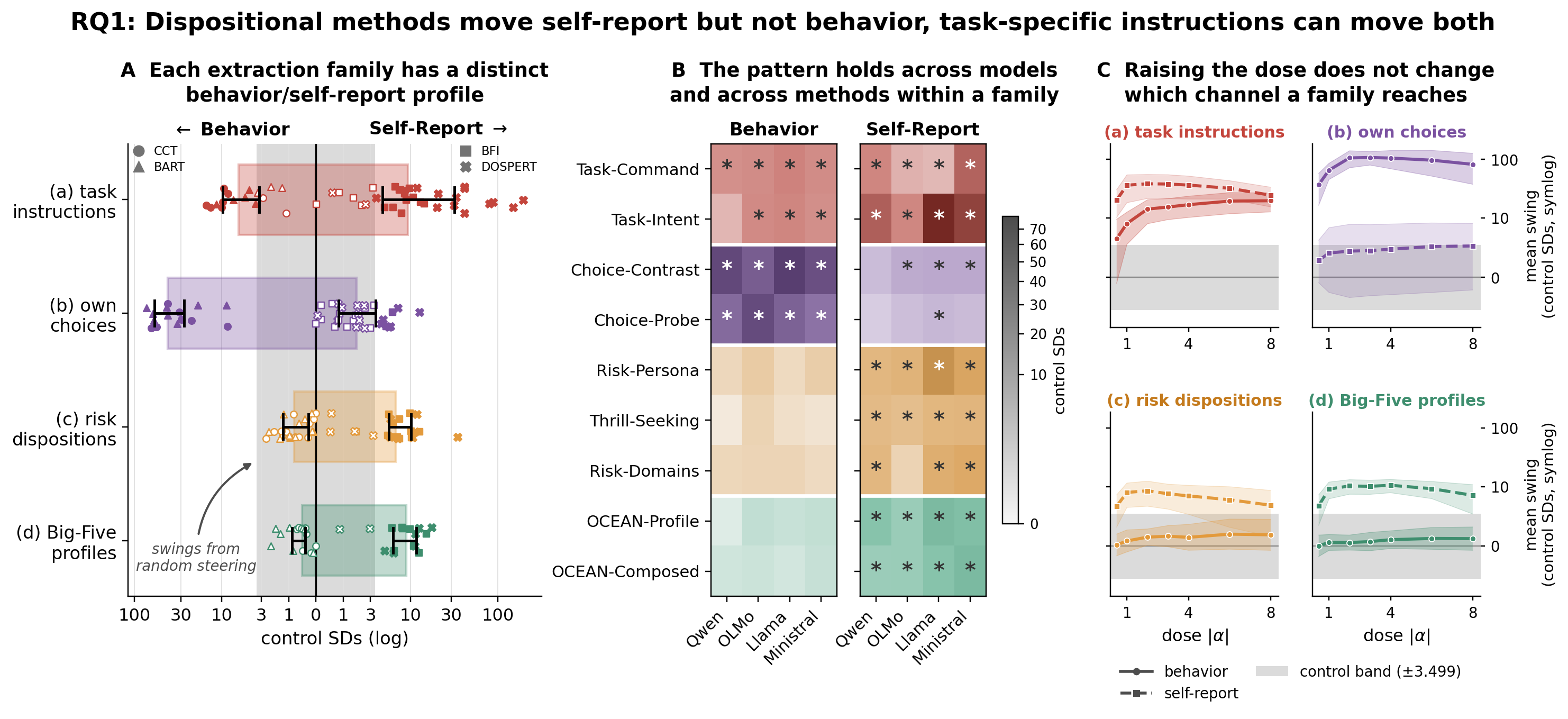
Steering applies a common intervention across both elicitations, with self-report and behavior kept in separate contexts to avoid cross-channel priming. The source and granularity of supervision determines which channel moves. Dispositional directions — risk-specific descriptions and Big Five profiles that never mention risk — clear the random-direction control in none of the 40 behavioral cells while clearing it in 31 of 40 self-report cells. Directions built from the model's own task decisions do the reverse: they clear the control in all 16 behavioral cells (median swing 42 control SDs) while self-report effects stay inside the control band. Only task-specific instructions reach both channels, and higher doses do not bring additional families across. Steering a model to describe itself as a risk-taker does not reliably make it take risks.

RQ2 (Diagnosing Dissociation): How are self-report and behavior encoded?

RQ2 results: geometry of steering directions and retention after removals

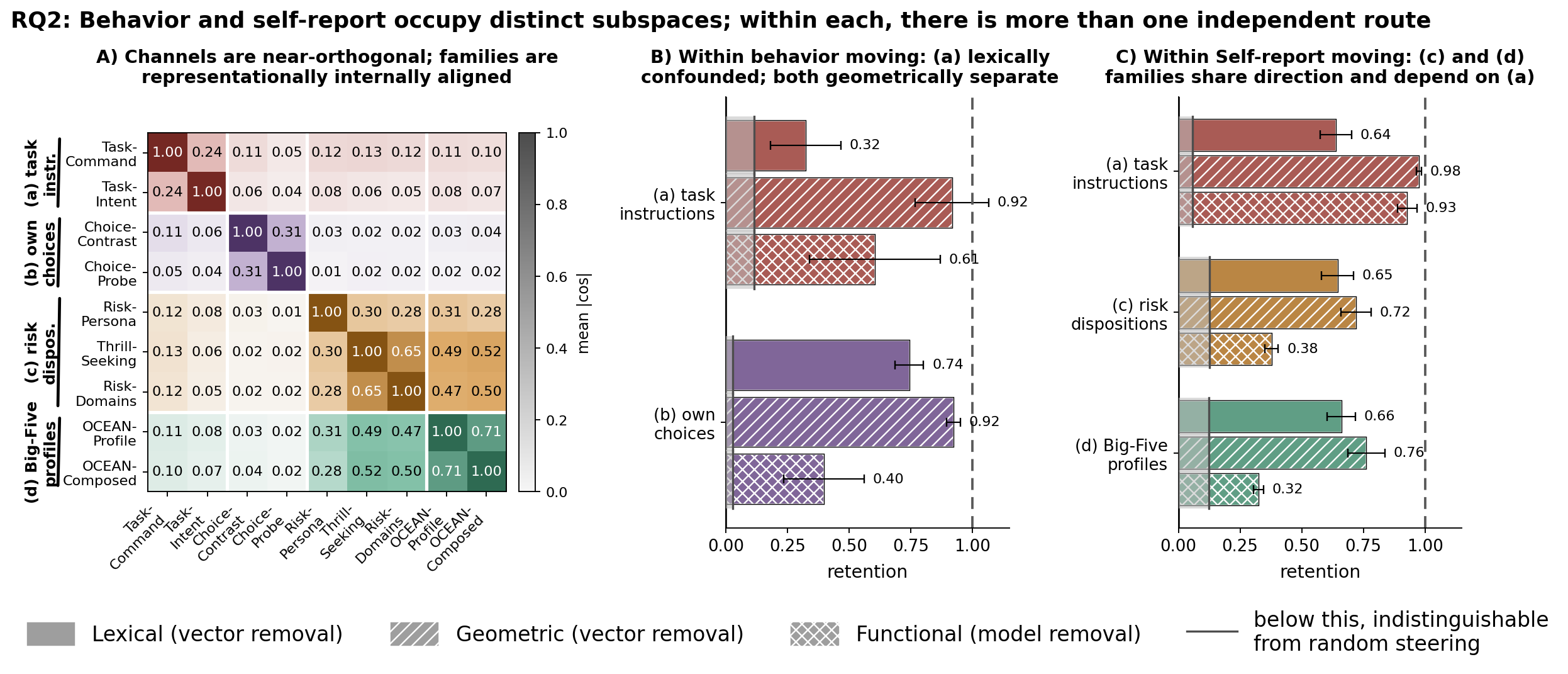
Steering directions are geometrically separate across channels: they are far more aligned within than across channels, and family pair explains 60% of the variation in pairwise cosine, versus 4.5% for layer depth. The apparent exception from RQ1 does not survive diagnosis — removing twelve lexical shortcut directions (mostly quantity cues) leaves task directives only 32% of their behavioral effect, against 74% for own-choice directions, and the purified directive effect never clears the control across doses. Within self-report, the dispositional families overlap: each survives removal of another family individually, but joint removal leaves only 7% of the risk-specific effect. Route removal, which ablates a direction from the hidden states rather than from the vector, causes larger losses still, indicating downstream dependence beyond the directions themselves.

RQ3 (Joint Control): Can the two channels be driven into coherent and anti-coherent states?

RQ3 results: coherence and anti-coherence under composed steering directions

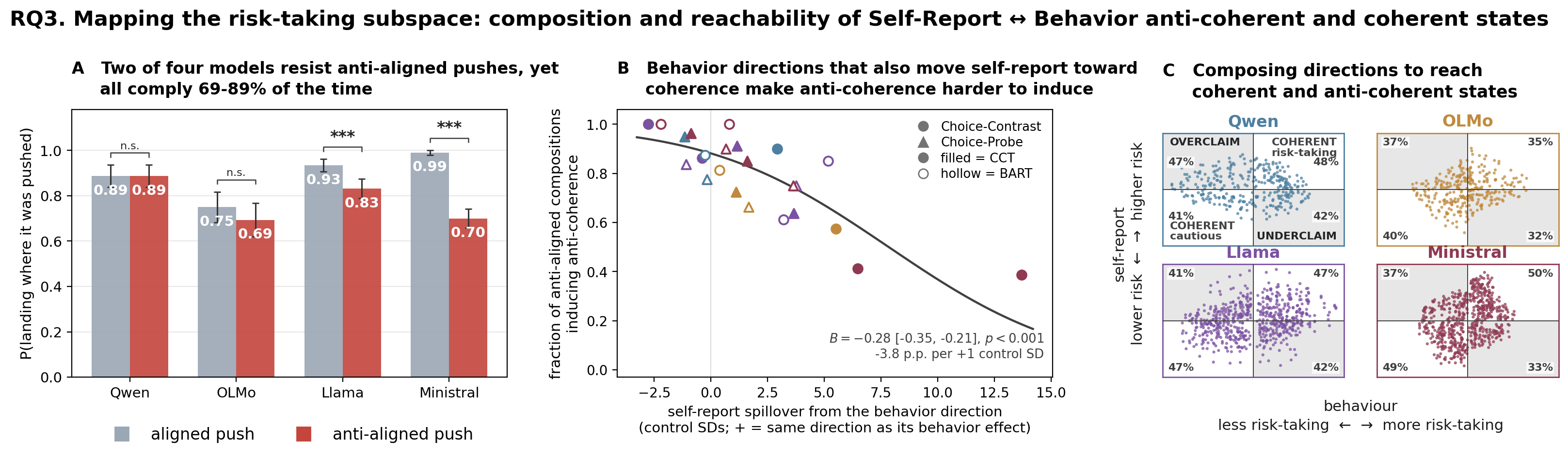
Composing one behavior-moving and one self-report-moving direction induces coherence in 91% of cases. Reversing the sign of the self-report component raises anti-coherence from 8.5% to 77.4%, a 69 percentage-point difference that is significant in every model. Resistance to anti-coherence exists but is limited and model-dependent: anti-aligned compositions reach their target state 14 p.p. less often than aligned ones, yet still induce anti-coherence in 69–89% of cases in all four models. That resistance tracks spillover — each additional control SD by which the behavior direction also moves self-report toward coherence is associated with a 3.8 p.p. lower anti-coherence rate. A model can be made to report and enact opposite levels of risk at the same time.

Conclusion: The gap is representational, not merely a prompting artefact.

Inspecting model internals, we find that for risk-taking the two channels are moved by largely separate directions, determined by their source of supervision. Only narrow task-specific instructions reach both, mostly through wording cues, and composing directions induces coherent and anti-coherent states with little resistance. Output agreement is therefore weak evidence of a shared internal mechanism. This motivates mechanistically informed behavioral auditing and intervention: testing whether such agreement has a representational basis, and shaping it directly, which is crucial if self-report is to serve as an audit of behavior.

Citation

@article{kocielnik2026representational,
  title={Representational Control over Self-Report and Behavior Coherence in LLM Risk-Taking},
  author={Kocielnik, Rafal and Song, Peiyang and Han, Pengrui and Marmarelis, Myrl G and Debnath, Ramit and Mobbs, Dean and Alvarez, R Michael},
  journal={arXiv preprint arXiv:2610.04125},
  year={2026}
}